


DNA in Criminal Cases: By Chris Morales Good Morning Everybody. Big part of my practice has to do with DNA in murder cases, rape cases any sort of violent crime there is usually DNA left by the suspect.That DNA ends up being analyzed by the crime lab and reanalyzed by defense criminalists. DNA Profiling: DNA analysis is a process by which characteristics of a suspect’s genetic structure are identified, compared with samples taken from a crime scene, and if a match, subjected to statistical analysis
to determine the frequency with which the characteristics occur in the general population. What that means is that a piece of DNA that is found in a crime scene will be analyzed. It will be typed and then the authorities will look for a match. So when a criminalist and scientist will look for. This is a double helix. This is sorta what DNA looks like. This is important because when a criminalist/scientist is looking for DNA they will go to ten different spots in the double helix and analyze the amount of DNA there.
And that will give them the DNA of the suspect. Now the DNA is unique to every human being in the world. Everyone has there own DNA except there is one exception. What is that exception? Identical Twins have the exact same DNA. A criminal technician that comes to the crime scene what do they do.They look for objects that can, whether there is a likely hood of DNA so condoms, soda cans, cigarette butts, clothing, weapons, underwear, sheets, pillow cases, postage stamps, and hair. They will collect that evidence very carefully with gloves to not infect it and ruin anything
package it up and take it back to the crime lab. What are they looking for in those objects. They are looking for blood, semen, skin, saliva, perspiration and hair. All of these, every cell in your body has DNA that you can look for except for red blood cells. Not blood but red blood cells do not have any DNA. The criminalist will take the DNA back and type it and they will go to those ten spots on the double helix and they will measure the DNA there. Then they will attribute that measurement to a number.
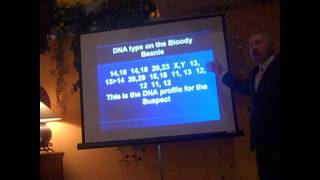
Now in every one of those ten spots there will be two pieces of DNA . Why is that? From the mother and the father. All our DNA we get one contribution from the mother and one contribution from the father and it all comes together and that is the DNA. So this is actual DNA type of a case I am handling actually right now. So you see each part of the double helix the criminalist has found and put a number here. 1416, 1418 and that is the amount of DNA found in that particular spot and the first one
is for the father and second one is for the mother. Now so the criminalist goes they collect DNA at the scene they type it. Now they have those numbers right here. Well so what? How do they find the actual suspect just with these numbers. Well there are a couple ways. So possible they have a suspect in mind, possibly somebody saw somebody leave the scene of the crime with blood on their shirt and so they will have a suspect in mind. The detectives will get a search warrant for that suspects’ body.The detective will go
to that suspect and say we have a search warrant for your body to give us a saliva sample. They will type that saliva sample and see if there is a match. There is a California database anyone who has convicted of a felony or any particular misdemeanor they have to give a DNA sample and the authorities can run that DNA that they got from the crime scene in that database and see if they have any matches there. At the very end of the rode when we are in court the judge still has note that this DNA
is actually reliable enough to put in front of a jury. So the criminalist needs to come up with an actual number. The judge asks the criminalist what is the likely hood of a random person having this exact DNA that you found at the crime scene. And the criminalist will come up with a number. I seen numbers one in four trillion, so that means that number that they found is pretty solid. Sometimes its one in eight hundred that means that the typing of the crime scene is not so reliable and maybe that is not going to go in front of
the jury. So that’s my presentation are there any questions.